

STATE TIMES NEWS
NEW DELHI: Stepping up its efforts to evacuate thousands of Indians stuck in Ukraine, the government on Monday decided to send four Union ministers to the neighbouring countries of the war-torn country to coordinate the evacuation process even as the external affairs ministry said nearly 8,000 nationals have returned in the last fortnight.
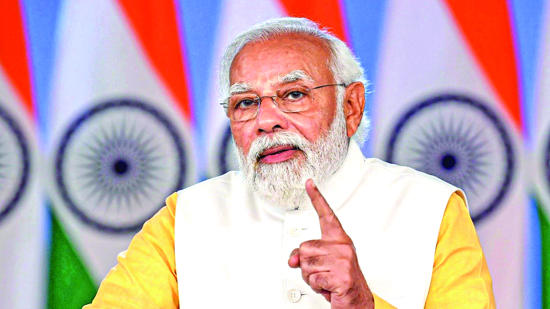
The decision to send Hardeep Puri, Jyotiraditya Scindia, Kiren Rijiju and V K Singh as “special envoys” of India to coordinate the evacuation process was taken at a meeting chaired by Prime Minister Narendra Modi, who also held another high-level meeting in the evening on Ukraine, government sources said.
Official sources said Modi spoke to all four ministers personally to convey the decision that they will be coordinating evacuation efforts on the ground from the countries in Ukraine’s neighbourhood.
Ukraine slows Russian advance under shadow of nuclear threat
KYIV: Outgunned but determined Ukrainian troops slowed Russia’s advance and held onto the capital and other key cities at least for now.
In the face of stiff resistance and devastating sanctions, President Vladimir Putin ordered Russia’s nuclear forces put on high alert, threatening to elevate the war to a terrifying new level.
Explosions and gunfire that have disrupted life since the invasion began last week appeared to subside around Kyiv overnight, as Ukrainian and Russian delegations met Monday on Ukraine’s border with Belarus.
It’s unclear what, if anything, those talks would yield.
Terrified Ukrainian families huddled in shelters, basements or corridors, waiting to find out. Exact death tolls are unclear, but the UN human rights chief said 102 civilians have been killed and hundreds wounded warning that figure was likely a vast undercount and Ukraine’s president said at least 16 children were among the dead.
More than 500,000 people have fled the country since the invasion, another UN official said Monday among the millions who have left their homes.
Russia’s Central Bank scrambled to shore up the tanking ruble Monday and the US and European countries upped weapons shipments to Ukraine.
While they hope to curb Putin’s aggression after he unleashed Europe’s biggest conflict since World War II, the measures also risked pushing an increasingly cornered Putin closer to the edge.
I sit and pray for these negotiations to end successfully, so that they reach an agreement to end the slaughter, and so there is no more war,” said Alexandra Mikhailova, weeping as she clutched her cat in a makeshift shelter in the strategic southeastern Ukrainian city of Mariupol.
Around her, parents sought to console children and keep them warm.
In Kyiv, long lines formed outside supermarkets on Monday as residents were allowed out of bomb shelters and homes for the first time since a curfew imposed Saturday.
The relative lull in warfare Monday morning in Ukraine was unlikely to last.
Neighbouring Belarus could send troops to help Russia as soon as Monday, according to a senior American intelligence official with direct knowledge of current US intelligence assessments.
The official spoke on condition of anonymity because he was not authorised to speak publicly.
US officials say they believe the invasion has been more difficult, and slower, than the Kremlin envisioned, though that could change as Moscow adapts.
The British Defense Ministry said Monday that the bulk of Putin’s forces are about 30 kilometers (20 miles) north of Kyiv, their advance having been slowed by Ukrainian forces.
Western nations ramped up the pressure with a freeze on Russia’s hard currency reserves, threatening to bring Russia’s economy to its knees.
Russians withdrew savings and sought to shed rubles for dollars and euros, while Russian businesses scrambled to protect their finances.
In addition to sanctions, the US and Germany announced they will send Stinger missiles to Ukraine among other military supplies.
The European Union, founded to ensure peace on the continent after World War II, is supplying lethal aid for the first time, including anti-tank weapons and ammunition.
At least one Western country is studying a request from Ukraine to provide fighter jets, a European official said.
She spoke on condition of anonymity to discuss information not yet public.
EU defense ministers were to meet Monday to discuss how to get the pledged weaponry into Ukraine.
Germany’s defense minister said without elaborating that her country has channels and possibilities to do that, and a trainload of Czech equipment arrived Sunday. Blocking off those shipments will clearly be a key Russian priority.
It remains to be seen how much the weaponry will help Ukraine fend off Russia’s vastly greater arsenal.
The increasingly erratic Putin made a clear link between ever-tightening sanctions and his decision Sunday to raise Russia’s nuclear posture.
He also pointed at aggressive statements by NATO as a reason for his move, a reference to his long-running stance that the US-led alliance is an existential threat to Russia.
US and British officials played down Putin’s nuclear threat, and its practical meaning was not immediately clear.
Russia and the United States typically have land- and submarine-based nuclear forces that are prepared for combat at all times, but nuclear-capable bombers and other aircraft are not.
A tiny sliver of hope emerged as talks began between Ukrainian and Russian officials Monday.
Ukrainian President Volodymyr Zelenskyy’s office said it would demand an immediate cease-fire.
While Ukraine sent its defense minister and other top officials, the Russian delegation is led by Putin’s adviser on culture, an unlikely envoy for ending the war and a sign of how Moscow views the talks.
It wasn’t immediately clear what Putin was seeking in the talks or from the war itself.
Western officials believe Putin wants to overthrow Ukraine’s government and replace it with a regime of his own, reviving Moscow’s Cold War-era influence.
His comments Sunday raised fears that the invasion of Ukraine could lead to nuclear war, whether by design or mistake.
In New York, the 193-member UN General Assembly scheduled an emergency session Monday on Russia’s invasion.
With the Ukrainian capital besieged, the Russian military offered to allow residents to leave Kyiv via a safe corridor, raising fears a further onslaught is coming. The mayor of the city of nearly 3 million had earlier expressed doubt that civilians could be evacuated.
Authorities have been handing out weapons to anyone willing to defend the city. Ukraine is also releasing prisoners with military experience who want to fight, and training people to make firebombs.
Battles also broke out in Ukraine’s second-largest city, Kharkiv, and strategic ports in the country’s south came under assault from Russian forces.
Mariupol, a strategic port city on the Sea of Azov, is hanging on, said Zelenskyy adviser Oleksiy Arestovich.
The Russian military claimed Monday it had taken full control of Ukraine’s airspace after showering its air bases and air defense batteries with air and missile strikes. But a similar claim on the first day of the invasion turned out to be untrue, and US officials said Sunday that Moscow has failed to fully control Ukrainian skies.
In Mariupol, where Ukrainians were trying to fend off attack, a medical team at a city hospital desperately tried to revive a 6-year-old girl in unicorn pajamas who was mortally wounded in Russian shelling.
During the rescue attempt, a doctor in blue medical scrubs, pumping oxygen into the girl, looked directly into the Associated Press video camera capturing the scene.
Show this to Putin,” he said angrily.
The eyes of this child, and crying doctors.”
Their resuscitation efforts failed, and the girl lay dead on a gurney, covered by her blood-splattered jacket.
Nearly 900 kilometers (560 miles) away, Faina Bystritska was under threat in the city of Chernihiv.
I wish I had never lived to see this, said Bystritska, an 87-year-old Jewish survivor of World War II. She said sirens blare almost constantly in the city, about 150 kilometers (90 miles) from Kyiv.
Among Western sanctions is a freeze on Russia’s hard currency reserves, which Putin had built up in recent years to increase the country’s economic independence.
The unprecedented move could have devastating consequences for the country’s financial system.
The US, European Union and Britain also agreed to block selected Russian banks from the SWIFT system, which facilitates moving money around thousands of banks and other financial institutions worldwide.
Scindia will take care of evacuation efforts from Romania and Moldova while Rijiju will go to Slovakia, sources said, adding Puri will go to Hungary and Singh will be in Poland to manage the evacuation.
The decision to send these ministers came a day after Modi asserted that ensuring the safety of Indian students and evacuating them is the government’s top priority.
Monday’s meeting was also attended by several ministers, including External Affairs Minister S Jaishankar and Commerce Minister Piyush Goyal, National Security Adviser Ajit Doval and Foreign Secretary Harsh Vardhan Shringla among other senior officials.
Also on Monday, Shringla briefed a parliamentary panel on the situation in Ukraine amid a Russian military offensive and India’s efforts to evacuate its citizens through land check-posts with five neighbouring countries, sources said.
They said the foreign secretary informed the Parliamentary Standing Committee on External Affairs that in the next two days the government is planning to operate 13 evacuation flights to the neighbouring nations of the war-torn country and the number of daily flights would be increased to nine.
During the briefing, Shringla also said that Russian-speaking officers had been sent to the border check-posts and Indian embassies in Ukraine’s five neighbouring countries — Hungary, Poland, Romania, Slovakia and Moldova — to boost evacuation efforts.
Asserting that India has managed to accelerate its efforts to get its nationals out of Ukraine in the last 24 hours, the MEA said a total of 1,396 Indians were brought back home in six flights as part of the evacuation mission.
MEA Spokesperson Arindam Bagchi also said the total number of Indians who have left Ukraine since India issued the first advisory earlier this month is around 8,000.
India is also sending humanitarian assistance to Ukraine, the ministry said.
Calling Modi’s decision to send four ministers a “visionary step”, Singh told reporters “I am leaving for Poland today and will coordinate with both Ukraine and Poland to facilitate the evacuation of Indian citizens stranded in Ukraine.”The other three ministers are likely to leave on Tuesday.
After Singh’s travel announcement, Poland’s Ambassador to India Adam Burakowski held a closed-door meeting with the Union minister.
Describing his meeting with Singh as “very good”, the ambassador said his country is allowing entry to people of all nationalities who are leaving war-hit Ukraine by road and food and shelter will be provided to them.
Amid reports claiming that Indians were facing difficulties on the Poland-Ukraine border, the ambassador said those who are trying to cross to Poland from Ukraine must refer to the social media handles of the Indian embassy in Warsaw and the Twitter handle of Operation Ganga.
“I would like to request all Indian nationals who are trying to cross to Poland from Ukraine that they must refer to the social media of the Indian Embassy in Warsaw and Twitter account of Operation Ganga,” Burakowski told PTI.
Modi had chaired a meeting on the Ukraine crisis on Sunday too.
It was decided at the meeting to further enhance cooperation with the neighbouring countries of Ukraine to expedite the evacuation of Indian students, sources had said.
According to sources, India has agreed to send humanitarian assistance including medical supplies to Ukraine at the request of the government there.