
Lalit Gupta
lalitguptajammu@gmail.com
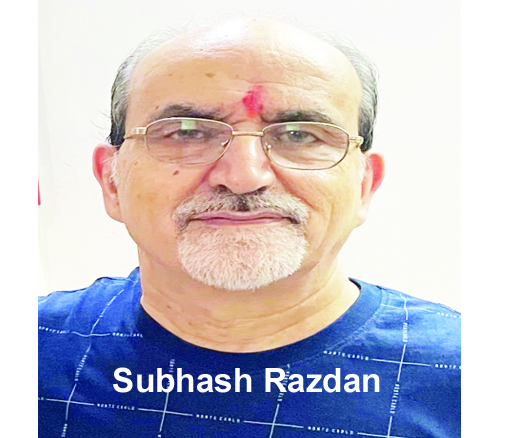 Subhash Razdan’s exhibition titled ‘Akshra’ created a kind of silent uproar within Jammu’s cultural circles. As the first of its kind exhibition that crafts an innovative visual dialect for interpreting the Sharda script, it has positioned itself at the intriguing cusp of art, linguistic heritage, and spirituality. Razdan’s latest works are not merely revivalist in intent; they seek to illuminate the spiritual content within the script, which the seers hailed as the Script of Knowledge and Ideas.
Hosted by Kala Kendra, Jammu, in the warm and contemplative space of the G. R. Santosh Art Gallery, the exhibition brought together artists, scholars, writers, and members of the Kashmiri community.
Rendered in a mixture of oil and acrylic, the scroll-based compositions in Akshra are not a mere display of calligraphic refinement but a metaphysical language whose curves, arcs, and rhythmic structures gesture toward the deeper realm of Kashmir Shaivism.
Regarding the development of Sharda and its sacred dimensions Dr. Shashi Shekhar Toshkhani in his magisterial exposition in the exhibition catalogue writes “As a writing system of historical importance, Sharda, like other Indian systems of writing, has descended from Brahmi script. It is a sibling of Devnagari and progenitor of major sub-families like Takari, Gurumukhi and Tibetan. It is named after Sharda, the goddess of learning and the arts. Her ancient temple, once a great place of pilgrimage, is now in ruins and is in Pakistan-occupied Jammu and Kashmir. From Kashmir, where it originated, the script spread across the entire north-western Himalayan region and beyond into Central Asia, serving as a primary medium for knowledge and ideas. Within India, it was in use as the main administrative, inscriptional and literary script in Kashmir, the present-day Himachal Pradesh and the plains of Punjab. Marginalised and replaced by Persian, which was the official script, Sharda became very restricted.”
“‘Paraavaak’, the goddess of speech, is perceived by the Shaiva Thinkers of Kashmir as the “primordial uncreated world”, identical with the highest form of energy. Taking the form of all letters of the Sanskrit alphabet, which are the code maps of the cosmos, it brings about the manifestation of the universe. Reflecting the non-dual Shaiva outlook, Abhinavagupta sees these phonemes (varnas) as “acoustic manifestations of consciousness” and “building blocks of all sounds”. Prior to their distinct emergence, they appear in their undifferentiated form within Shiva’s supreme consciousness as ‘shabdarashi’ or totality of the mass of all sounds. Mapped into word, the fifty phonemes of the Sanskrit alphabet represented in their graphic forms by letters of the Sharada/Devnagari script from ‘a’ to ‘ksha’, and classified into cases or ‘vargas’, function as the “secret code of phenomenal reality”. Being aspects of the divine energy of ‘paraavaak’, they are termed as ‘maatriksas’ and regarded as mother divinities.”
The present exhibition of works follows Razdan’s earlier solo exhibitions, Pashyanti (Jammu, 2014) and Samrasya (Delhi), yet marks a new direction in his artistic journey. As Dr. Shashi Shekhar Toshkhani observes, the present artistic project “seeks to correlate the mystic dimensions of Sharda alphabets with Abhinavagupta’s conception of the relation between the Word and World, between language and consciousness.” Akshra thus becomes more than an exhibition; it becomes a bridge between philosophical insight and creative expression.
It is from the above perspective that the artist Subhash Razdan looks at the Sharda alphabet and holds them sacred. His meditative gaze and “the overwhelming infinite creative delight that he feels in calligraphing letters and sacred syllables in Sharda script” form the basis of his present series of paintings. Under his inventive portrayal, Sharda alphabets stand transformed-alive, pulsating, as aspects of divine energy of the “Paraavaak”, the Supreme Word. He regards his calligraphy of Sharda as a new dimension of his artistic sensibility, which is grounded in the Tantrik overview”.
Razdan’s creative presentation of the ‘Vaks’ of Lalded in the background of their Shaivte concepts, is another highlight of the exhibition. Through his symbolic arrangement of the texts of the Vaks amidst color fields, he seems to allude to the spiritual turmoil felt by of the great Yogni.
Razdan’s personal history contributes significantly to the depth of the exhibition. Born in 1952 in the family of Ambar Nath Razdan and Ichhavati, at Purushyar, Habbakadal, Srinagar, his basic education took place in Hindu Middle School, Zaindar Mohalla, and Hindu High School, Sathu Sheetal Nath, Srinagar. He actually grew up as an artist at a tender age under the guidance of Girdhari Lal in Middle School and High School under Radha Krishan Raina, a graduate of Shri Amar Singh Technical Institute, Srinagar.
After schooling, he pursued non-medical studies at Amar Singh College, Srinagar. In 1972, he joined afternoon classes in the Institute of Music & Fine Arts (IMFA) to hone his artistic skills. Later encouraged by teachers at the Institute, he joined the Faculty of Fine Arts, M S University, Vadodara, for training in Applied Art and in 1979 completed post-graduation in Visualisation. Later, he served as an instructor in Applied Art at the Institute of Music & Fine Arts (1979-1988) before joining the University of Kashmir in 1988 as an Assistant. Prof. in the department of Media Research Education Centre. In 1990, after migration, he moved to Delhi.
His childhood exposure to the daily ritual life seeped in Kashmir Shaivism-watching elders conduct morning worship, observing the ceremonial drawing of gods and goddesses, and listening to the rhythm of sacred mantras and blowing of the Shankha-left a lasting imprint on his sensibility. Though he did a basic course in calligraphy while studying for his Bachelor of Fine Arts degree, it was his encounters with calligraphists and devotees who treated manuscripts with reverence and devotion-as spiritual doorways-that created a subtle yet powerful pull. Which eventually crystallised into his forays into Tantric cosmic geometry and then into the mystic world of the Sharda script, not as a series of linguistic phonemes but as luminous signs, carriers of cosmic energies waiting to be invoked by the devout in the space between form and formlessness.
Subhash Razdan’s ‘Akshra’ has opened a new pathway. “With tools-reed pens, bamboo ink and paint-in his hand, he set into motion the Wheel of ‘Maatraka’, giving shape and form to what is eternal and without form. His brushes glide with amazing spontaneity on the canvas, which represents the vastness of the inner spaces of the mind. Razdan’s calligraphy is an endeavour to encapsulate the inner meaning and the essence of all that the graphic beauty of the Sharda syllabary conveys”.
He has given a renewed visual life to Sharda by presenting it as a living linguistic and spiritual heritage, encouraging new generations to experience the script not as a distant past but as a resonant, breathing presence. In illuminating the spiritual in the Sharda script, Subhash Razdan has, in effect, illuminated an entire cultural imagination.
As a creative artist, Subhash Razdan also emerges as a connoisseur, joining a new generation of guardians of Sharda-linguists, programmers, teachers, and cultural historians.
The post Illuminating the Spiritual in Sharda Script appeared first on Daily Excelsior.