
PROF. (RETD) VERINDER SINGH MANHAS
The Article is dedicated in Memory of those who fought The Battle of Burki on 10 Sept. 1965
The Battle of Burki is one of the glorious battles between India and Pakistan in the 1965 war. Since the partition dividing India and Pakistan on 15th August 1947, India and Pakistan remained in contention over several issues, although the issue of Kashmir was the pre-dominant issue dividing the nation, there were several other border disputes existing allover the demarcation of boundary line between India and Pakistan by Cyrill Redcliffe, a Barrister in the University of London, invited by Lord Mountbatten in March,1947 but came for demarcation on 7th July 1947 after the passing of Indian Independence Act in the British Parliament.
The predominant border issue was the marshy and swampy areas in the Rann of Kutch between Gujarat and Rajasthan. Another border issue was the Thar desert of Rajasthan devoid of water for agriculture. Further the issue of Punjab, the fertile land of west Punjab was given to Pakistan and the remaining. Punjab was left to India. The boundary issue became pre-dominated.Over Kashmir ruled by Maharaja Hari Singh over a Muslim dominated population led by Sheikh Mohammad Abdullah. These boundary issues were parts of the two nation theory of Mohammad Ali Jinnah assisted by the Muslim Conference of Sheikh Abdallah in Kashmir.
In 1954 the United States signed an agreement with Pakistan on defence by giving seven hundreddollars to upgrade Military equipment.
After the defeat in 1962 Sino-Indian War, the Indian Military was undergoing major changes in personnel and equipment. During this period, despite being numerically smaller, than the Indian military Pakistan’s armed forces had a qualitative edge in airpower and armour over India, which Pakistan sought to use before India completed defence buildup. Pakistani soldiers began patrolling in territory controlled by India in Jammu and Kashmir which was followed by attacks both countries on each other posts on 8thApril 1965.
Pakistan launched “Operation Desert Hawk” and captured a few Indian posts near Kanjarkot Fort border area. In June1965 the British Prime Minister Harold Willson successfully persuaded both countries to end hostility. Both countries signed an agreement to settle the disputed border through international arbitration by the International Court of Justice, 30thJune 1965. A tribunal was set to resolve the dispute, the verdict which came later in 1968 saw Pakistan had already invaded and acquired 780sq. Km of the Rann of Kutch, as against its original claim of 9100 sq. km. Pakistan’s purpose for this operation was to assess the response of the Indian Govt. and military to come south of Kutch away from Punjaband Kashmir region.
After its success in the Rann of Kutch, Pakistan under the leadership of Mohd Ayub Khan believed the Indian Army would be unable to defend itself against a quick military campaign in the disputed territory of Kashmir as the Indian Military had suffered a loss to China in 1962 the Sino Indian War.
OPERATION GIBRALTAR: On 5thAugust 1965 Pakistan soldiers crossed the Line of Control dressed as Kashmir locals headed for various areas within Kashmir. These infiltrators carried out intelligences collected with the help of locals in cities like Gulmarg and Rajouri. Indian forces, tipped off by the local population captured several Pakistani soldiers who revealed that Pakistan was attempting to ignite the resistance movement employing a covert infiltration code named Operation Gibraltar. The operation was eventually was unsuccessful.
On 6thand 7thAugust Indian Forces engaged in skirmishes with several colons of Pakistani soldiers who tried to outcome communication lines and mix with the locals during celebrations.
The Indian Army crossed the Ceasefire line on 15th August and captured several peaks overlooking the Srinagar – Leh highway. By the end of Augudt, Pakistan had made progress in areas of Tithwal, Uri and Poonch.
OPERATION HAJI PIR:Stopping the influx of Pakistani troops into Uri -Poonch bulge, the Indian Army COAS J.N. Chaudhary,commandedthe XV Crops under Lt. Gen. KS Katoch to advance and take over Haji Pir Pass. Under the watch of Lt. Gen Harbaksh Singh led by Brig, Z C Bakshi of the 68 Infantry Brigade, Indian Forces Captured the Hazi Pir Pass, 8 km into Pakistan administered Kashmir by 28 August, 1965.
CHHAMB OFFENSIVE:On 1st Sept 1965, Pakistan launched a counterattack, called Operation Grand Slam, with the objective to capture the vital town of Akhnoor in Jammu, which would sever communications and cut off supply routes to Indian troops. Ayub Khan calculated that Hindu morale would not stand more than a couple of hard blows at the right time and place although by this time Operation Gribraltar had failed and India had captured Haji Pir Pass.
Towards Lahore: Ichogil Canal: The Battle of Burki.
After the failure of Operation Gibraltar, Operation Grand Slam and the failure of Pakistan in Chamb and Akhnoor, Pakistan had no other alternative to prevent Indian Forces to come towards Lahore. It was here that the Ichogil Canal the boundary between India and Pakistan came into limelight which was the International border on the western front. On 6th Sept, the Indian forces crossed Ichogil Canal and marched towards Lahore. President Ayub Khan on 6th Sept 1965 declared a state of emergency through Radio Broadcast proclaiming that Pakistan was in a state of war with India. On 6thSept the 15 Infantry Division of Indian Army under World War-II.
Veteran Major General Niranjan Prasad, battled a massive counter attack by Pakistan near the west bank of the Ichogil Canal, which was in fact border of India and Pakistan. The Generals entrouge itself was ambushed and he was forced to flee his vehicle.
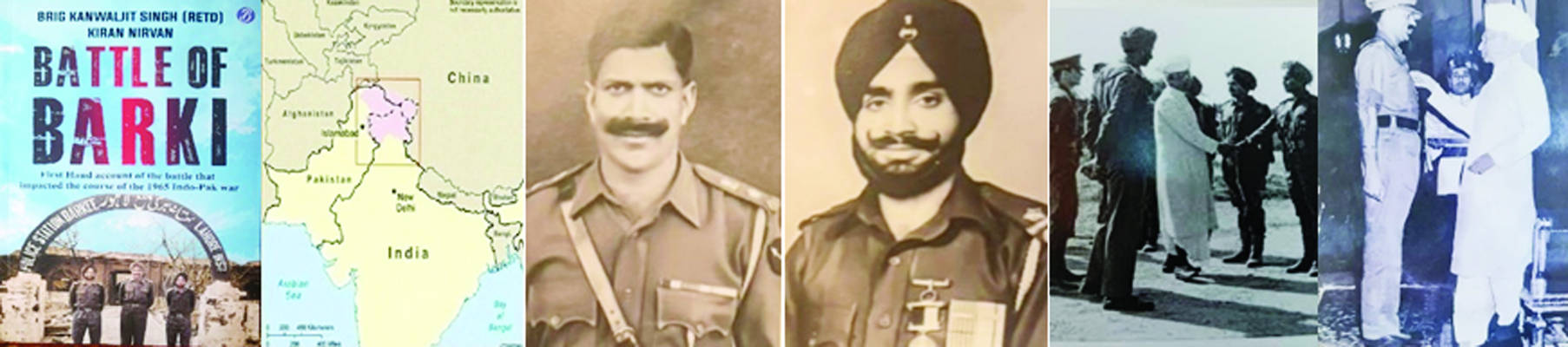
The Battle of Burki: The 7th Infantry Division under the command of Maj. Gen Har Kishan Sibal attempted an offensive on the canal on 6th September. The forces advanced through Khalra-Burki – Lahore road and reached Burki by 7th Sept. the famous 36 Sikh (4 Sikh) Regiment under the command of Col. Anant Singh was given a short notice on receipt of new weapons. The CO of 4 Sikh held a Sainik-Sammelan on 8th Sept with a Slogan “Nischay Kar Apni Jeet Karo”. These words echoed in the ears of hundreds, of Khalsa’s of 4 Sikh. The A Company under the leadership of Major Shashsher Singh Manhas marched towards Lahore where a fiercebattle took place on 10thSept where the Indian Forces of Sikh Regiment were fighting the enemy troops firing from bunkers.
The 4 Sikh captured a Police Post of Burki on the morning of 10th Sept.The firing continued and at 3:30 PM the company commander Shamsher Singh was injured in the ongoing battle. At this time the Brig. Comr. of 48 Brigade,7 INF. DIV, Brig. Farris ordered the other companies to move towards Lahore. It was here that the Pakistan Army under Armoury of Patton Tank’s besieged the three companies and took them as Prisoners of Wars (POW). Yet even after the injury of company Commander the Khalsa’s of 4 Sikh never gave up capturing the entire Burki Village. The company Commander Major Shamsher was awarded the Veer Chakra (VrC) on 10thSept 1965.
The Battle of Burki is glorious since it had a Battle Honour day on 12thSept 1897 in which the 21 Sikh Khalsa’s of XXXVI Sikh, under the command of Hav. Isher Singh fought gallantly against the Afghan tribes under Russian Imperialismagainst the Indo British Nationalists.
All the 21 Sikh Soldiers of the 36 Sikh were given posthumously the Indian Order of merit (10m). At the time, this was the highest gallantry award for Indian Soldier’s under British rule, equivalent to the Victoria Cross.
(The writer is Geography Department (University of Jammu), Ex CSRD/SSS/ JNU)