
“Nehru wanted to build Babri mosque using public funds, but Sardar Patel thwarted his plans”
STATE TIMES NEWS
VADODARA: Operation Sindoor is proof that India gives a befitting reply to those who do not understand the language of peace and goodwill, Defence Minister Rajnath Singh said on Tuesday as he likened the action against terrorism to the strong will and leadership of Sardar Vallabhbhai Patel.
He also said the first Prime Minister, Jawaharlal Nehru, wanted to build “Babri masjid” using public funds, but Patel didn’t allow his plans to succeed.
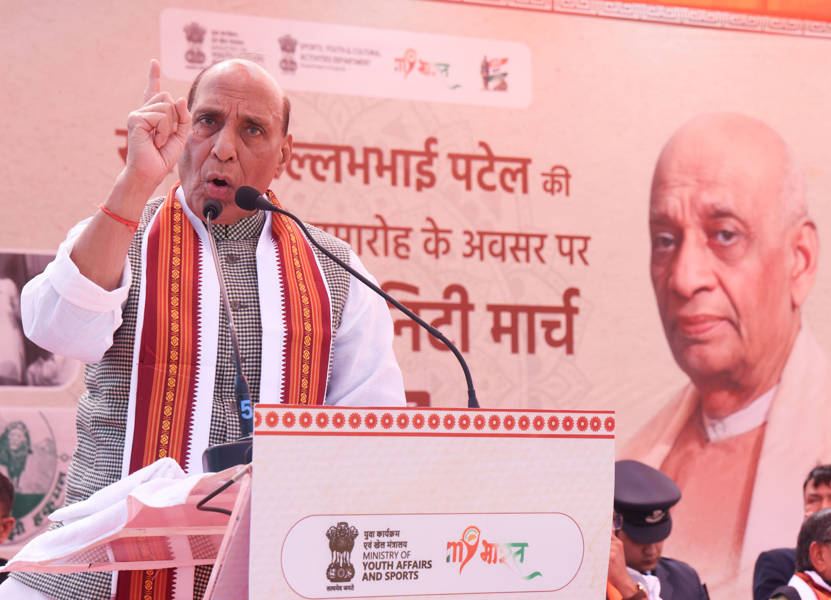
Singh addressed ‘Sardar Sabha’ at Sadhli village in Gujarat’s Vadodara district as part of the “Unity Marcha” organised by Mera Yuva (MY) Bharat under the Ministry of Youth Affairs & Sports to commemorate the 150th birth anniversary of Patel.
Commending the courage and dedication of the armed forces for the successful execution of Operation Sindoor, Singh said the world is today acknowledging the bravery and capabilities of Indian soldiers.
He said Patel always believed in resolving problems through dialogue.
“However, when all avenues were blocked, he didn’t hesitate to adopt a tough approach. When the need arose for Hyderabad’s merger, Patel took that stance.
“Had he not adopted a tough stance, perhaps Hyderabad would not have been a part of India,” said Singh, referring to Patel’s tenure as the first home minister of India.
He said the Modi government has also upheld this value through Operation Sindoor.
“India showed the world through Operation Sindoor that it is capable of giving a befitting reply to those who do not understand the language of peace and goodwill. Operation Sindoor is being discussed not only on Indian soil but also in other countries around the world”, Singh said.
Operation Sindoor sent a clear message that “we are a peace-loving nation which never provokes any country, but if provoked, does not spare those who try to cast an evil eye”.
Singh targeted Nehru, saying, “Pandit Jawaharlal Nehru wanted to build the Babri Masjid (in Ayodhya) using public funds. If anyone opposed this proposal, it was Sardar Vallabhbhai Patel, born to a Gujarati mother. He didn’t allow the Babri Masjid to be built using public funds”. When Nehru raised the issue of restoring the Somnath Temple in Gujarat, Patel clarified that the temple was a different matter because Rs 30 lakh required for its facelift had been donated by common people, he added.
“A trust had been established, and not a single penny of the government’s money had been spent on this (Somnath temple) work. Similarly, the government didn’t give a single rupee to construct the Ram Temple in Ayodhya. The entire cost was borne by the people. This is called real secularism,” he said.
Under the leadership of PM Modi, Patel’s vision of ‘One India, Best India’ has been strengthened further,” the defence minister said.
He said removing Article 370 was not a small feat, and it was PM Modi who connected Kashmir with India by doing so.
“By turning the weakness for which the world was taunting us at that time into a strength, Sardar Patel showed the country the way forward. And following that path, India, surrounded by doubts, now talks to the world on its own terms, not on the terms of other countries,” Singh said.
India is rapidly moving towards becoming the world’s largest economic and strategic power, he added.
He said the government is carrying forward the national security vision of Sardar Patel who had emphasised on defence modernisation and indigenous production of weapons and ammunition.
“Today, due to the ‘Make-in-India’ initiative, we are becoming self-reliant in defence production, while exporting military equipment to friendly countries. Our defence exports have increased nearly 34-fold in the last 11 years. We aim to achieve defence production worth Rs 3 lakh crore and defence exports worth Rs 50,000 crore by 2029”, he said.
Singh stated that Patel’s entire life was a symbol of purity and honesty and was inspired by these high ideals.
He said the government aims to get the Constitution (130th Amendment) Bill 2025 passed in Parliament, which requires those in the highest positions to behave ethically against corruption.
“This means that if a person in office is arrested under any serious charge and is not granted bail within 30 days, they will be automatically relieved from their post,” he added.
Singh said Patel could have become the Prime Minister, but he never hankered for any position.
Despite ideological differences with Nehru, he worked with him because he had given a promise to Mahatma Gandhi, the defence minister added.
He claimed that Nehru became the president of Congress in 1946 because Patel withdrew his nomination on Gandhi’s advice, despite a majority of the Congress committee members proposing his name.
Singh said some political forces wanted to erase Patel’s legacy. “It was PM Narendra Modi whose crucial role re-established Patel as a shining star in the annals of history”.
“After Patel died, common people collected funds to build a memorial for him, but when this information reached Nehruji, he said Sardar Patel was a leader of farmers, so this money should be spent on building wells and roads in the village.
“What a farce! Building wells and roads is the government’s responsibility. The suggestion of using memorial funds for that was absurd,” said Singh.
This indicated that the government of that time wanted to hide and suppress Patel’s great legacy at all costs, he added.
“Nehruji awarded himself the Bharat Ratna, but why was Sardar Vallabhbhai Patel not honoured with the Bharat Ratna at that time? Modiji decided to honour Sardar Patel appropriately by building the Statue of Unity. This is truly commendable work by our PM,” Singh said.
He also dismissed arguments that Patel was too old to become the Prime Minister.
“This is completely wrong. Morarji Desai was over 80 years old. If he could become prime minister of India, why couldn’t Sardar Patel, who was under 80?” asked Singh.
Singh said if demands raised by Patel had been heeded at the time of Kashmir’s merger, India wouldn’t have had to grapple with the Kashmir problem for so long.