

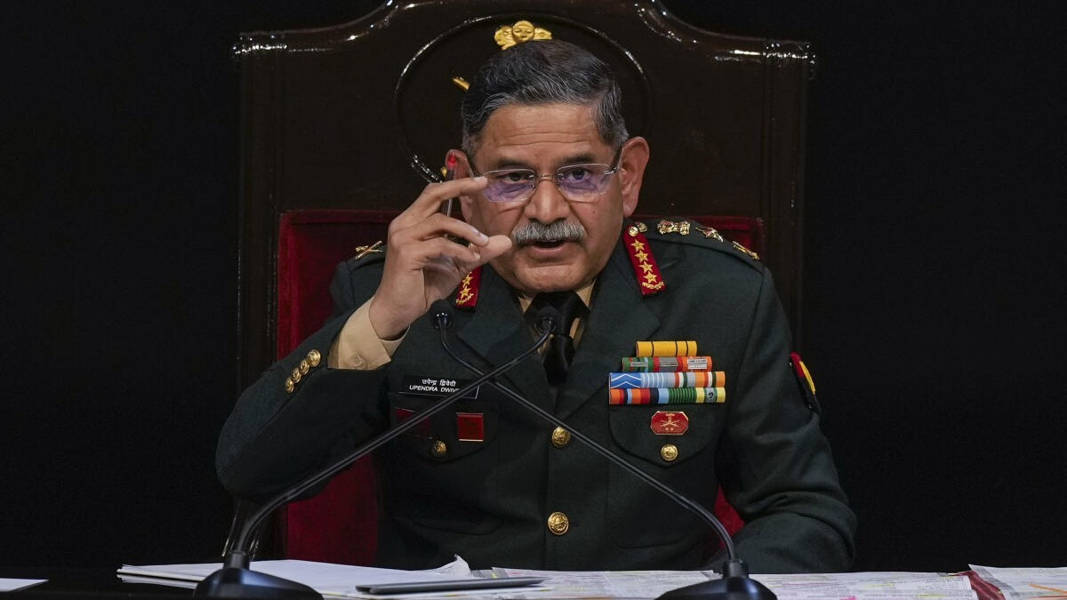
NEW DELHI: Army Chief Gen Upendra Dwivedi said on Tuesday that the situation along the frontier with China in eastern Ladakh remains “stable but needs constant monitoring” even as he warned Pakistan against any “misadventure” in the western sector.
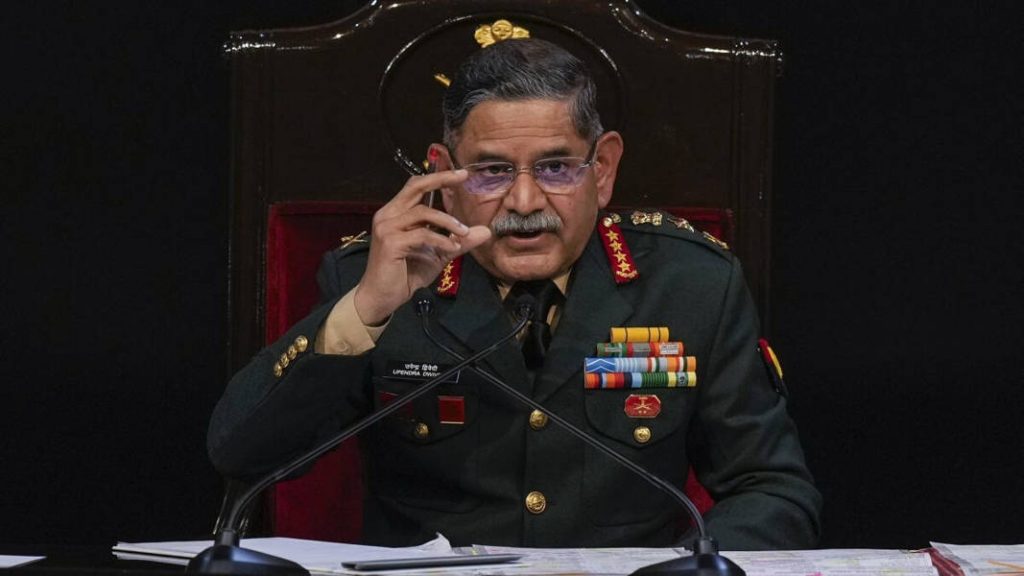
The Army Chief said India’s “resolute” response under Operation Sindoor against cross-border terrorism provided strategic clarity and that his force had made forward mobilisation as part of preparations for ground offensives following the hostilities with Pakistan.
Gen Dwivedi, addressing a press conference ahead of the Army Day, said the troops were subsequently pulled back by the end of May, but asserted that “our eyes and ears are open” and “any misadventure” by the adversary will be dealt with effectively.
The Army Chief also mentioned “two turning points” during Operation Sindoor — one of them being the 22-minute strike on terror targets in the early hours of May 7, while the other being “certain directions” given to the Indian military on May 10 on what to do if the conflict escalated.
In response to the Pahalgam terror attack, India launched a series of precision missile strikes on terror camps in Pakistan and Pakistan-Occupied Kashmir, eliminating at least 100 terrorists in response to the horrific Pahalgam terror attack that killed 26 innocent civilians.
General Dwivedi said at least six terror camps are still active across the Line of Control and two across the International Border even after Operation Sindoor, and India will act if any nefarious activities are carried out. He said 100-150 terrorists are present in these camps.
The Chief of Army Staff also listed a series of measures the Army has initiated to bolster its combat prowess that included raising new units such as Bhairav light commando battalions, Shaktibaan regiments, Divyaastra artillery regiments and Ashni platoons.
He said the government has approved the long-pending proposal to set up Integrated Battle Groups (IBGs), which will comprise a mix of infantry, artillery, air defence, tanks and logistics units.
The IBGs are expected to revamp the Army’s warfighting capabilities, particularly along the borders with China and Pakistan.
Gen Dwivedi, extensively delving into Operation Sindoor, said it remains “ongoing” and “any future misadventures will be resolutely responded to.”
“Through 22 minutes of initiation on May 7 and an orchestration that lasted 88 hours up to May 10, the operation reset strategic assumptions by striking deep, dismantling terror infrastructure and puncturing long-standing nuclear rhetoric,” he said.
The Army successfully destroyed seven out of the nine targets and thereafter played a pivotal role in ensuring a calibrated response to Pakistan’s actions, he added.
On the situation along the Line of Actual Control (LAC) with China, Gen Dwivedi said it “remains stable but needs constant vigil.”
“Apex-level interactions, renewed contact and confidence-building measures are contributing to gradual normalisation of the situation. This has also enabled grazing, hydrotherapy camps and other activities along the northern borders,” he said.
“With our continued strategic orientation on this front, our deployment along the LAC remains balanced and robust. Concurrently, capability development and infrastructure enhancement are progressing through a whole-of-government approach,” he said.
Gen Dwivedi, without elaborating, also indicated that India and China have carried out “troop readjustment” as part of larger goals to keep the LAC stable.
The Chief of Army Staff also asserted that the Shaksgam Valley belongs to India.
Pakistan illegally ceded 5,180 sq km of Indian territory in the Shaksgam Valley to China in 1963 from areas illegally occupied by it.
“As far as the Shaksgam Valley is concerned, India considers the 1963 agreement between Pakistan and China as illegal,” he said.
“We don’t approve of any activity in the valley. The Ministry of External Affairs has already stated this clearly. Therefore, the joint statement which has been issued in China, what I understand about the CPEC 2.0, we do not accept it, and we consider it an illegal action being carried out by the two nations,” he said.
India has been severely critical of the so-called China-Pakistan Economic Corridor (CPEC) that passes through Pakistan-Occupied-Kashmir.
Gen Dwivedi also said that the situation in Jammu and Kashmir remains “sensitive but firmly under control.”
“In 2025, 29 terrorists were eliminated, of which 59 per cent were Pakistan-origin, including the three perpetrators of the Pahalgam attack neutralised in Operation Mahadev,” he said.
“Active local terrorists are now in single digits. Terrorist recruitment is almost non-existent — only two in 2025.” The theme of “terrorism to tourism” is gradually taking shape, he said.
Expanding on the two turning points during Operation Sindoor, Gen Dwivedi said: “The first was the 22-minute strike on terrorist targets, which derailed the opposite side’s decision-making, and they took time to take that all in.”
“Following this, there was confusion among them, and that led to mismanaged responses, which were met with our calibrated response.”
“The second turning point was on the morning of May 10. The tri-forces were given certain directions about what to do if this war had escalated. They had understood it, and hence, they called our DGMO (Director General of Military Operations).
“They (Pakistan military) had complete information about which ship, which strike or pivot, which core unit, or which aircraft was moving where, all from satellites. When they connected these dots, they said that the time had come to stop the war,” he said. (PTI)