

Ranbir Singh Pathania
rspathaniamla@gmail.com
In an era of global economic headwinds-tight monetary policies, fractured supply chains, and geopolitical storms-Union Budget 2026-27 emerges as a beacon of fiscal churn for India. Presented by Finance Minister Nirmala Sitharaman, it caps the fiscal deficit at a disciplined 4.3% of GDP while ramping up capital expenditure to a record Rs 12.2 lakh crore, a 9% jump from last year. This is no populist giveaway; it’s a structural pivot from short-term relief to long-term execution, redefining India’s economic grammar. Petty populism is no longer the mood. The fastest growing economy requires a faster trajectory too, to transact. Nowhere is this shift more tangible than in Jammu & Kashmir (J&K), where allocations signal a deliberate move from crisis management to productive autonomy.
A Comparative Lens: Breaking from Past Patterns
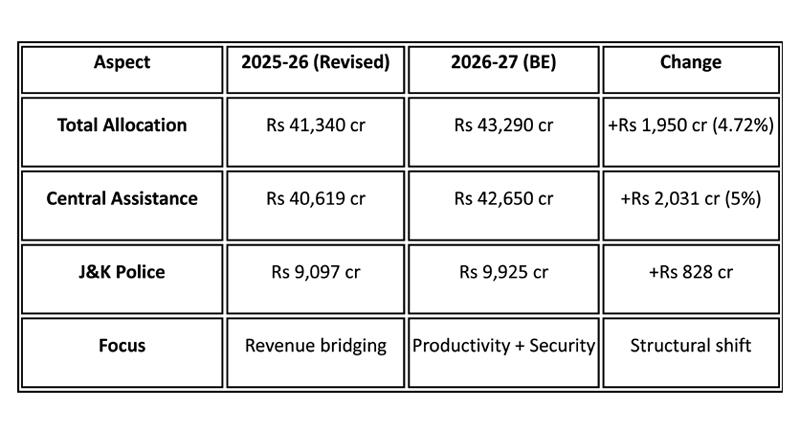
Prior budgets for J&K, especially post-Article 370 abrogation in 2019, leaned heavily on relief amid uncertainty. In 2024-25, actual spending hit Rs 46,000 crore, but Budget Estimates for 2025-26 dipped to Rs 41,000 crore (revised to Rs 41,340 crore), reflecting tighter fiscal consolidation. Critics decried this as underfunding, yet 2026-27 reverses the trend with Rs 43,290 crore-a 4.72% rise (Rs 1,950 crore more than 2025-26 revised)-including Rs 42,650 crore in central assistance to plug revenue gaps. J&K Police funding surges to Rs 9,925 crore from Rs 9,097 crore, prioritizing security as the bedrock of progress.
This isn’t mere incrementalism. Unlike 2025-26’s broad support, 2026-27 embeds “fiscal prophylaxis”-pre-empting instability-with targeted productivity boosters. While earlier outlays focused on salaries and basics, this budget channels funds into high-value sectors, aligning with national Atmanirbhar 2.0: strategic self-reliance without isolation.
Security First: Foundation for Development
J&K’s Rs 43,290 crore is not merely a blank-cheque welfare; Rs 9,925 crore fortifies police infrastructure under direct Union Home Ministry control. This reinforces that economic revival hinges on law-and-order. Post-Pahalgam attack losses irked traders, who felt 2026 allocations fell short of tourism hits. Yet, by anchoring aid in stability, the budget prevents fiscal uncertainty from derailing services like salaries-crucial after years and years of volatility.
Sectoral Pivot: From Raw Exports to Value Capture
Agriculture transforms via the National Nut Crop Programme, tailoring high-value walnuts, almonds, and pine nuts to J&K’s agro-climatic edge. Kisan Credit Cards expand from Rs 3 lakh to Rs 5 lakh, paired with cold storage, pack-houses, and value-addition-retaining wealth locally instead of raw outflows.
Tourism matures beyond volume: Ecologically sustainable mountain trails, ropeways, and heritage circuits position J&K as a year-round premium destination. Training 10,000 professional guides formalizes a nascent economy, echoing national services export ambitions, (10% global share by 2047).
Disaster resilience shines: Rs 259 crore for Jhelum-Tawi Flood Recovery and Rs 79 crore for the Disaster Response Fund shift from compensation to mitigation-vital in a flood-prone region.
Atmanirbhar Bharat, Reinterpreted
Crucially, this Budget redefines Atmanirbhar Bharat. Self-reliance here does not imply inward-looking economics, but strategic autonomy- the mood of the moment- reducing dependence in critical sectors such as semiconductors, biopharma, energy, and rare minerals, while remaining deeply integrated with global markets.
The emphasis on “Kartavya”-duty-led growth-captures this ethos. Growth is not pursued as an end in itself, but as a responsibility: to future generations, to fiscal stability, and to regions that were, till today, peripheral to India’s economic story.
Conclusion: A Budget with New Direction & Meaning
Union Budget 2026-27 may not be the most dramatic in rhetorical terms, but it is among the most consequential by design. It replaces emergency thinking with execution discipline, legal complexity with institutional trust, and regional appeasement with region-specific strategy.
For India, it provides economic ballast at a volatile global moment.
For Jammu & Kashmir, it embeds development within stability and security.
And for the idea of a Viksit Bharat by 2047, it moves the conversation decisively from intent to implementation.
In public finance, that transition often marks the difference between ambition and achievement.
(The author is member of J.K Legislative Assembly)
The post Jammu & Kashmir in Union Budget 2026-27 From Stability to Strategic Growth appeared first on Daily Excelsior.