

STATE TIMES NEWS
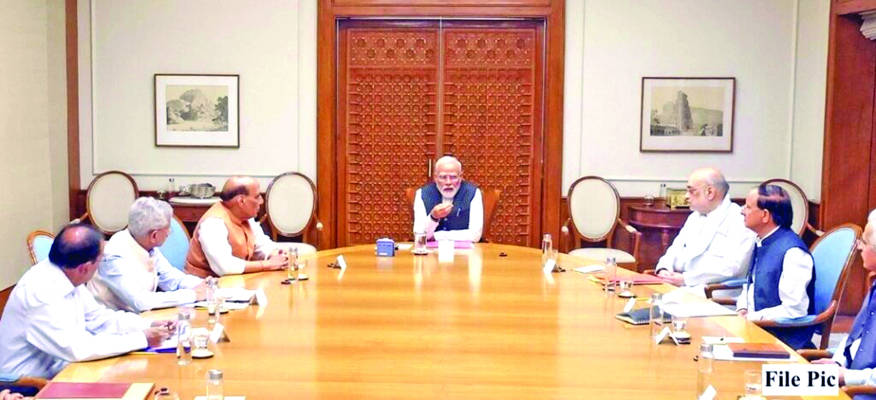
NEW DELHI: Prime Minister Narendra Modi on Sunday night chaired a meeting of the Cabinet Committee on Security, the highest decision-making body on security and strategic matters of the country, and it is learnt to have discussed the evolving situation arising out of the fresh conflict in West Asia.
The meeting was convened to take stock of the situation emerging in the wake of the attack on Iran by the US and Israel and the killing of Iran’s Supreme Leader, Ayatollah Ali Khamenei.
“The prime minister chaired a meeting of the Cabinet Committee on Security (CCS),” a source said, without disclosing details of the meeting.
The CCS meeting was held shortly after Modi arrived in the national capital at around 9.30 pm following his two-day tour of Rajasthan, Gujarat, Tamil Nadu and Puducherry.
The meeting, which was attended by committee members, including Defence Minister Rajnath Singh, Home Minister Amit Shah, External Affairs Minister S Jaishankar and Finance Minister Nirmala Sitharaman, was briefed by top officials on the prevailing situation in West Asia and its implications on India, the sources said.
National Security Advisor Ajit Doval, principal secretaries to the prime minister, P K Mishra and Shaktikanta Das, Chief of Defence Staff General Anil Chauhan, Cabinet Secretary T V Somanathan and Foreign Secretary Vikram Misri also attended the meeting.
It is believed that the meeting discussed the safety of Indian nationals living in West Asia, and also those who are stranded, and how to deal with the situation if it deteriorates, the sources said.
Currently, the airspace of West Asia is almost closed.
With flight services disrupted due to the military escalation in West Asia, hundreds of Indians are stranded in Dubai, Doha and other key airports in the region, with many taking to social media to appeal to the Indian government for assistance.
The meeting is also learnt to have taken stock of the situation arising out of the closure of the Strait of Hormuz, which is a major shipping route for Indian oil carriers, by the Iranian authorities, the sources said.
There are around 10,000 Indian citizens who live, study and work in Iran, while over 40,000 live in Israel. The number of Indians living in the Gulf and West Asia is about nine million.
In the past, India successfully evacuated thousands of its nationals from different parts of the world, including West Asia, amid conflicts.
The Ministry of External Affairs (MEA) said Indian missions across the region are in continuous contact with its nationals, while helplines have also been activated.
Iran’s Supreme Leader Khamenei was killed in a major attack on Iran launched by Israel and the United States early Saturday. Iranian state television and the state-run IRNA news agency announced the 86-year-old’s death early Sunday.
US President Donald Trump said it gave the Iranians their “greatest chance” to “take back their country”.
The heavy and pinpoint bombing was to continue through the week or as long as necessary, Trump said.
Iran responded to the assault by firing drones and missiles at Israel and US military installations around the Gulf region, and also at the global business hub of Dubai.
On Sunday, mourners belonging to the Shia community took to the streets in various parts of India to express outrage and grief over the killing of Khamenei.