
-
Govt exempts pregnant women, others with disabilities from attending offices
-
Administering precaution vaccine dose to start from today
STATE TIMES NEWS
New Delhi/Mumbai: Several states imposed fresh restrictions to check the COVID-19 surge and Prime Minister Narendra Modi reviewed the situation at a high-level meeting on Sunday as cases continued to rise with 1,59,632 new infections reported, the highest in 224 days.
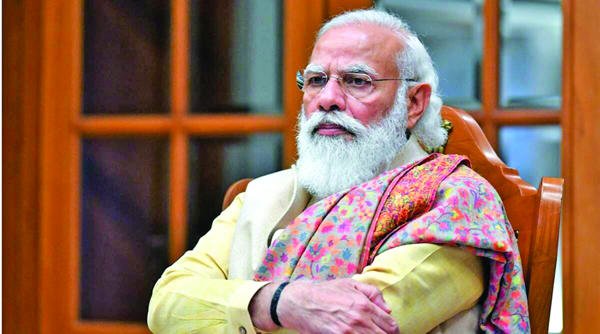
The prime minister called for ensuring adequate health infrastructure in districts, boosting vaccine drive for adolescents in mission mode and continuing the public campaign focused on COVID-appropriate behaviour as they were critical in the battle against the pandemic.
From Monday, the country would start administering precaution dose of COVID-19 vaccine to healthcare workers, frontline workers including personnel deployed for election duty and those aged 60 and above with comorbidities.
Prime Minister Modi said that a meeting with chief ministers will be convened to discuss state-specific scenarios, best practices and public health response, according to the Prime Minister’s Office. Most states and Union Territories, including Maharashtra, Karnataka, Uttar Pradesh, Haryana, Rajasthan, Himachal Pradesh and Delhi, have already announced night curfew and other restrictions in the wake of the imminent third wave.
The Himachal Pradesh government on Sunday banned social and religious functions till January 24. It also prohibited any gathering of more than 100 people for indoor and 300 people for outdoor academic, sport, cultural and political events, according to an order.
Attendance of staff at state government offices was capped at 50 percent. The restrictions, however, will not be applicable to emergency services.
The Rajasthan government announced the closure of schools in municipal areas till January 17, a Sunday curfew and restricted market timings and occupancy at restaurants and movie theatres.
A one-day complete lockdown was enforced across Tamil Nadu and most roads and other public places wore a deserted look.
Suburban and other train operations, bus and other public transport services including the Metrorail in Chennai were suspended.
Chief Minister M K Stalin had earlier ordered fresh curbs which included state-wide night curfew between 10 PM and 5 AM with effect from January 6.
Puducherry government also announced that all schools conducting offline classes for students from classes 1 to 9 will remain shut from Monday.
Maharashtra health minister Rajesh Tope said the state government will gradually bring curbs at places of worship and other sites, including liquor vends, that attract crowds to control the coronavirus pandemic.
He, however, said that even as cases are rising, hospital bed occupancy and oxygen demand remain low.
“When these start rising, we will enforce stricter restrictions,” he added.
On Saturday, when Maharashtra reported over 41,000 new COVID-19 cases, the state government decided to prohibit movement in public in groups of five or more from 5 AM to 11 PM. Further, no movement will be allowed in public from 11 PM to 5 AM except for essential services, a government circular had said.
However, people continued to gather in large numbers at places like the Juhu beach.
On Sunday, the state government revised the COVID-19-related restrictions for gyms and beauty salons, allowing them to operate at 50 percent capacity from January 11.
The state government has announced closure of schools and colleges till February 15. The government had also decided to cap the attendance at marriages and social, religious, cultural or political gatherings at 50.
In the national capital, which was under weekend curfew, Chief Minister Arvind Kejriwal said there is no plan to impose a lockdown as of now and that there will be no need for it if people wear masks.
Rising COVID-19 cases are a matter of concern but there is no need to panic. Very few people are getting hospitalised. Wearing mask is very important,” he said.
The national capital has been seeing an uptick of daily cases in the last few days, mainly triggered by the Omicron variant of the infection.
“There will be no lockdown if you continue to wear a mask. There is no plan to impose lockdown as of now, Kejriwal, who was also infected but has now tested negative, said at a virtual press conference.
According to Union health ministry data updated at 8 AM on Sunday, a total of 1,59,632 new coronavirus infections were reported, the highest in 224 days, while the active cases increased to 5,90,611, the highest in around 197 days.
On May 29 last year, India had logged 1,65,553 infections in a day during the deadly second wave.
India logged 552 new cases of Omicron, taking the total tally of such infections to 3,623 across 27 states and UTs so far.
Out of the total Omicron cases, 1,409 people have migrated or recovered.
Maharashtra has recorded the maximum number of 1,009 Omicron cases so far followed by Delhi at 513, Karnataka 441, Rajasthan 373, Kerala 333 and Gujarat 204.
The death toll climbed to 4,83,790 with 327 fresh fatalities, the data stated.
The active cases comprise 1.66 percent of the total infections, while the national COVID-19 recovery rate decreased to 96.98 percent, the ministry said.
The number of people who have recuperated from the disease surged to 3,44,53,603 while the case fatality rate was recorded at 1.36 percent.
The cumulative doses administered in the country so far under the nationwide COVID-19 vaccination drive have exceeded 151.58 crore.
In an unprecedented step, the Election Commission had on Saturday banned public meetings and rallies in poll-bound states of Uttar Pradesh, Punjab, Uttarakhand, Manipur and Goa in view of the COVID-19 situation.
According to the latest directions, 50 per cent of officials and staff below the rank of Under Secretary or executive officer are required to work from home till the end of this month.
The working hour of all employees who attend office on a particular day has been staggered between 10 am and 10:30 am with corresponding office exit timings to avoid rush in commuting as also in lifts and corridors.
Those with disabilities and pregnant women are exempt from attending offices. Starting and closing timings of the secretariat have been staggered to avoid crowding. All official meetings will be held virtually.
India will start administering the precaution dose of Covid vaccine to healthcare and frontline workers and comorbid people aged 60 and above from Monday in a bid to stymie the coronavirus spread driven by its Omicron variant.
Personnel deployed for election duty in poll-bound Uttar Pradesh, Uttarakhand, Punjab, Manipur and Goa have also been designated as frontline workers.
Union Health Minister Mansukh Mandaviya, in a tweet on Sunday, said reminder SMSes have been sent to over one crore healthcare and frontline workers and senior citizens for their precaution dose.
An estimated 1.05 crore healthcare and 1.9 crore frontline workers, and 2.75 crore comorbid people in the 60 plus age group would be administered the precaution dose according to schedule, Health Ministry sources said.
There would be no mix-and-match of vaccines for the precaution dose. The beneficiaries would be given the same vaccine as their previous two jabs.
According to guidelines issued by the Union Health Ministry, the gap between the date of administering the second dose of vaccine and the precaution dose would be nine months (39 weeks).
CoWIN will send reminder messages to all those eligible for this dose and after administration of the shot, it will be noted in the digital vaccination certificate.
Online appointments for precaution dose began on the CoWin portal on Saturday evening. However, there is also the option of an onsite appointment and it will start on January 10.
“The government is ensuring the security of the health army that keeps the country secure. Reminder SMS have been sent to more than one crore health and frontline workers and 60+ citizens for their precaution dose. Appointments on COWIN are already open. Administering the doses will start tomorrow,” Mandaviya said in a tweet in Hindi.
Acccording to the Health Ministry, private hospitals that function as COVID-19 Vaccination Centres can inoculate their eligible staff members.
Those aged 60 years and above with comorbidities will not be required to produce or submit any certificate from a doctor at the time of administration of the precaution dose of vaccine.
The countrywide COVID-19 vaccination drive was rolled out on January 16 last year with healthcare workers getting inoculated in the first phase. The vaccination of frontline workers started from February 2.
The next phase of inoculation commenced from March 1 for people over 60 years of age and those aged 45 and above with specified co-morbid conditions. The country launched vaccination for all people aged more than 45 years from April 1.
The government then decided to expand its vaccination drive by allowing everyone above 18 to be vaccinated from May 1. COVID-19 vaccination for adolescents in the age group of 15-18 years commenced from January 3.