
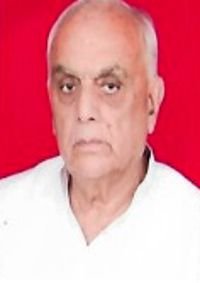
Er P L Khushu
‘Even though you may be able to do everything else but meditate, you will never find joy to equal that which comes when the thoughts are silent and your mind is tuned to the peace of God.” – Sri Sri Paramahansa Yogananda .
Meditation is the science of God realization. It is the most practical science in the world. Most people would want to meditate if they understood its value and experienced its beneficial effects. The ultimate object of meditation is to attain conscious awareness of God, and the soul’s eternal oneness with Him. What achievement could be more purposeful and useful than to harness limited human faculties to the omnipresence and omnipotence of the Creator? God realization bestows on the meditator the blessings of the Lord’s peace, love, joy, power, and wisdom. Meditation utilizes concentration in its highest form. Concentration consists in freeing the attention from distractions and in focusing it on any thought in which one may be interested. Meditation is that special form of concentration in which the attention has been liberated from restlessness and is focused on God. Meditation, therefore, is concentration used to know God. The first proof of God’s presence is an ineffable peace. This evolves into joy humanly inconceivable. Once you have touched the Source of truth and life, all nature will respond to you. “Finding God within, you will find Him without, in all people and all conditions.” – Sri Sri Paramahansa Yogananda,
Paramahansa Yogananda, was an Indian monk, yogi and a guru who introduced millions to the teachings of meditation and Kriya Yoga through his organization “Yogoda Satsanga Society of India”. He lived his last 32 years in America. A chief disciple of the Bengali yoga guru Swami Sri Yukteswar Giri, he was sent through his lineage to spread the teachings of yoga to the West, to prove the unity between Eastern and Western religions and to preach a balance between Western material growth and Indian spirituality. His long-standing influence in the American yoga movement, and especially the yoga culture of Los Angeles, led him to be considered by yoga experts as the “Father of Yoga in the West. Yogananda was the first Indian Yogi to settle in America, and the first prominent Indian to be hosted in the White House, by President Calvin Coolidge in 1927. He published his book Autobiography of a Yogi in 1946. This book conveys lot of spiritual messages as a Yogi. He was the most influential spiritual Gurus, from India in the first half of the 20th century, after Swami Vivekananda, Swami Ramtirth including Swami Raman Maharishi and Maharishi Mahesh Yogi. Paramahansa Yogananda was born to Mukunda Lal Ghosh on January 5, 1893, in Gorakhpur, India, in a devout and well-to-do Bengali family. From his earliest years, it was evident to those around him that the depth of his awareness and experience of the spirituality was far beyond the ordinary. Both his parents were disciples of Lahiri Mahasaya, the renowned master who was instrumental in reintroducing Kriya Yoga in modern India. When Yogananda was an infant in his mother’s arms, Lahiri Mahasaya blessed him and foretold: “Little mother, thy son will be a yogi. As a spiritual engine, he will carry many souls to God’s kingdom”. It was in 1910, at the age of seventeen that he met and became a disciple of the revered Swami Sri Yukteswar Giri. In the hermitage of this great master of yoga he spent the better part of the next ten years, receiving Sri Yukteswar’s strict but loving spiritual discipline. At their very first meeting, and on many occasions thereafter, Sri Yukteswar told the young disciple that he had been chosen as the one to disseminate the ancient science of Kriya Yoga in America and worldwide.
After graduating from Calcutta University in 1915, he took formal vow as a monk of India’s venerable monastic Swami Order, at which time he received the name Yogananda (signifying bliss, ananda, through divine union and yoga). His ardent desire to consecrate his life to the love and service of God thus found fulfillment. In 1917, Yogananda founded a school for boys in Dihika, West Bengal, which combined modern educational techniques with yoga training and spiritual ideals. A year later, the school relocated to Ranchi.
When Yogananda was still an infant, his mother had two unusual experiences. The first occurred when she brought the baby Yogananda with her to an audience with Lahiri Mahasaya. Her spiritual teacher placed the infant in his lap and then predicted Yogananda’s extraordinary future: “Little mother, thy son will be a yogi. As a spiritual engine, he will carry many souls to God’s kingdom.”
Yogananda when he was six years old, the second unusual event occurred when a wandering sadhu visited and foretold that a silver amulet would miraculously materialize in Yogananda’s mother’s hand during a meditation session and that she would die young. The sadhu also advised Yogananda’s mother to arrange for the amulet to be passed to Yogananda one year after her death. When Yogananda reached the tender age of 11, the sadhu’s prediction came true. His profound grief over his mother’s passing sparked his interest in the practice of spiritual discipline and the path of self-realization. A year later, one of Yogananda’s brothers revealed that their mother had entrusted him with an amulet before she died. True to her instructions, he gave it to Yogananda a year after her passing. When Yogananda received it, he was overwhelmed by the experience of a “blaze of illumination” and the awakening of many dormant memories. He was convinced that the powerful magical silver amulet was a gift from the teachers of his former lives. [Source: om-guru.com]
Yogananda is said to have possessed psychic powers as a child. He had little interest in his secular education and always tried to find ways to do as little academic work as possible. At one point, while he was still in college, he decided to go to the Himalayas on a pilgrimage. However, one of his brothers found out and brought him back home.
In 1920, he received an invitation from the American Unitarian Association to serve as India’s delegate to an International Congress of Religious Liberals convening that year in Boston. Seeking out his guru’s advice, Sri Yukteswar advised him to go. Later while in deep prayer in his room, he received a surprise visit from Mahavatar Babaji, the Great Guru of his lineage, who told him directly that he was the one chosen by the Masters to spread Kriya Yoga to the West. Reassured and uplifted, Yogananda soon afterwards accepted the offer to go to Boston. This account became a standard feature of his lectures. He spoke at the International Congress in early October, and was well received; later that year he founded the Self-Realization Fellowship (SRF) to disseminate worldwide his teachings on India’s ancient practices and philosophy of Yoga and its tradition of meditation. In 1925, he established an international center for Self-Realization Fellowship in Los Angeles, California, which became the spiritual heart of his growing work. Yogananda was the first Hindu teacher of yoga to spend a major portion of his life in America. He lived in the United States from 1920 to 1952, interrupted by an extended trip to India and other countries in 1935-1936, and through his disciples he developed various Kriya Yoga centers around the world.
In August 1935, he arrived in India and also met other various people who caught his interest, like Mahatma Gandhi, whom he initiated into Kriya Yoga; woman-saint Anandamoyi Maa Giri Bala, an elderly yogi woman who survived without eating; renowned physicist Chandrasekhara Venkata Raman, and several disciples of Sri Yukteswar’s Guru Lahiri Mahasaya. While in India, Sri Yukteswar gave Yogananda the monastic title of “Paramahansa”, meaning and indicating the highest spiritual attainment, which formally superseded his previous title of “Swami. In March 1936, upon Yogananda’s return to Calcutta after visiting Brindaban, Sri Yukteswar attained mahasamadhi, at his hermitage in Puri. After conducting his guru’s funeral rites, Yogananda continued to teach, conduct interviews, and meet with friends for several months, before planning to return to the US in mid-1936.
According to his autobiography, in June 1936, after having a vision of Krishna, he had a supernatural encounter with the resurrected Spirit of his guru Sri Yukteswar while in a room at the Regent Hotel in Mumbai. During the experience, in which Yogananda physically grasped and held on to his guru’s solid form, Sri Yukteswar explained that he now served as a spiritual guide on a high-astral planet, and expounded truths in deep detail regarding, the astral realm, astral planets and the afterlife, the lifestyles, abilities and varying levels of freedoms of astral beings; the workings of karma; man’s various super physical bodies and how he works through them, and other metaphysical topics. With new wisdom and renewed from the encounter, Yogananda and his two western students left India via ocean liner from Mumbai; staying for several weeks in England, they conducted several yoga classes in London and visited historical sites, before leaving for the US in October 1936. In the days leading up to his death, Yogananda began hinting to his disciples that it was time for him to leave the world. On March 7, 1952, he attended a dinner for the visiting Indian Ambassador to the US, Binay Ranjan Sen, and his wife at the Biltmore Hotel in Los Angeles. At the conclusion of the banquet, Yogananda spoke of India and America, their contributions to world peace and human progress, and their future co-operation, expressing his hope for a “United World” that would combine the best qualities of “efficient America” and “spiritual India. Immediately after that he entered mahasamadhi, when the cause of death was heart failure. Rajarsi Janakananda, who Yogananda chose to succeed him as the new president of the Self-Realization Fellowship, “performed a sacred ritual releasing his body to God.
(The author is a Chartered Consultant Civil Engineer who has fascination for his Motherland the Union Territory of Jammu & Kashmir).