
STATE TIMES NEWS
NEW DELHI: The Narendra Modi government has taken many important steps to provide better opportunities for education, health and employment to the people of “hitherto left neglected” Jammu and Kashmir and Ladakh, President Ram Nath Kovind said on Monday.
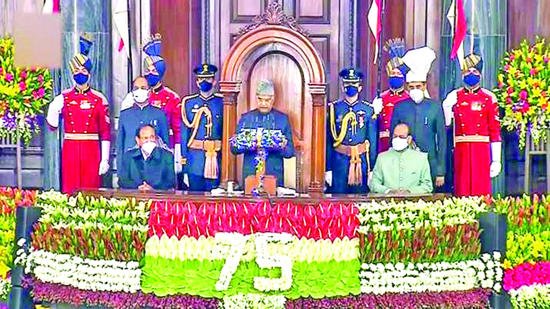
Addressing a joint sitting of both houses of Parliament at the start of the budget session, Kovind said at the “Amrit Kaal” of independence, the Centre’s resolve of “Ek Bharat, Shreshtha Bharat” (one India, greatest India) is enabling the country to write a new chapter of development on the basis of democratic values and it is now making special efforts for the states and regions “hitherto left neglected”.
“The beginning of a new era of development in Jammu and Kashmir and the Ladakh region is a great example of this,” he said.
The president said the government has started a new central sector scheme for the industrial development of Jammu and Kashmir at a cost of about Rs 28,000 crore.
Last year, the Qazigund-Banihal tunnel was opened to traffic and international flights between Srinagar and Sharjah have also started, he pointed out.
“Many important steps have also been taken to provide better opportunities for education, health and employment to the people of Jammu and Kashmir,” Kovind said.
He said currently, work is in progress on seven medical colleges and two All India Institute of Medical Sciences (AIIMS) — one in Jammu and another in Kashmir. The construction of IIT, Jammu and IIM, Jammu is also going on in full swing.
Kovind said the Sindhu Infrastructure Development Corporation has been set up to accelerate infrastructure and economic development in the Union Territory of Ladakh.
Another chapter in this development journey of Ladakh is being added in the form of Sindhu Central University, he said.
Article 370 of the Constitution, which gave a special status to the erstwhile state of Jammu and Kashmir, was scrapped on August 5, 2019 and it was bifurcated into the Union territories of Jammu and Kashmir and Ladakh. Both the Union territories are currently under central rule.
He said the areas where naxals operate and perpetrate violence have come down significantly over the years and now 70 districts in the country are affected by the menace, from an earlier 126 districts.
Kovind also said that a peace accord has been signed with insurgent groups in Assam’s Karbi Anglong district to end decades long conflict, and a new chapter of peace and prosperity has been ushered.
“Due to concerted efforts of my government, the number of naxal-affected districts in the country has also come down from 126 to 70 today,” he said.
On September 21, 2020, the then Union minister of state for home G Kishan Reddy had informed Rajya Sabha that a total of 90 districts in 11 states in the country are considered naxal or left-wing extremism (LWE) affected, and are covered under the Security Related Expenditure scheme of the home ministry.
Reddy had also said that LWE-related violent incidents were reported in 61 districts in 2019 and in only 46 districts in the first half of 2020.
According to home ministry data, between 2004-2020, 8,380 people were killed by the Maoists in different parts of India.
The majority of civilians killed were tribals. They were often branded as ‘police informers’ before being brutally tortured and killed.
The tribal and the economically underprivileged sections, whose cause the Maoists claim to espouse, have been the biggest victims of the so-called ‘protracted peoples war’ of the naxals, the home ministry has said.
Referring to the insurgency in the Northeast, the president said the efforts of the Modi government to establish peace in the region have attained “historic success”.
“Just a few months ago, a settlement was reached between the central government, the state of Assam and the Karbi groups to end the decades-old conflict in Karbi Anglong. This has ushered in a new chapter of peace and prosperity in the region,” he said.