
Omkar Dattatray
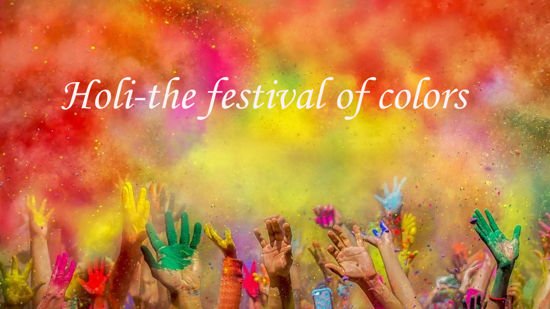
India is a country of diverse cultures, traditions, customs, rituals and festivals and in different parts of the country different festivals are celebrated with pomp and show. Holi is one such festival and is rightly called as the festival of colors but is celebrated although in different ways across the length and breadth of India, however sprinkling of the colors is common to all parts of the country. The festival of Holi fosters the unity and togetherness among the people of the country and therefore this festival of colors has got special importance for national cohesion and unity. The festival of Holi is celebrated to bade goodbye to winter and to welcome the season of spring and thus the Holi symbolizes positivity in life and is celebrated to encourage and have the feeling of positivity which is so important for life of the individual. This festival is celebrated to discourage and shun all negativity in lives of the people. The question is as why do the people celebrate festival of Holi and different legends stand woven around the celebration of the festival. In fact as already said Holi is celebrated in honor of the arrival of spring, the end of winter, the blossoming of love and for many it is the festive day to meet others, play, laugh, forget and forgive and above all to repair broken relationships. The festival also celebrates the beginning of a good spring harvest season. Generally it lasts for a night and a day, starting on the evening of the Purnima-full moon day falling in the Hindu calendar month of Phalguna, which falls around the middle of March in the Gregorian calendar. The first evening is known as Holika Dahan, marking burning of demoness Holika or Chhoti Holi, followed by Holi. The Holi festival in India is a celebration of the victory of good over evil, the destruction of the demoness Holika. It is said that Harenyakashap, a cruel king was asking all to worship him as he proclaimed to be the one and all, the God and even wanted his son Prahlad who was the Vishnu bagaht also to worship him. But Prahlad did not accede to it and so Harenyakashyap ordered that his son to be burned along with his own sister Holika who was resistant to fire due to some blessings. So it was conspired that Prahlad would be burnt in lap of his aunt. But a miracle happened that no harm was caused to Prahlad, however his aunt Holika got burnt and was reduced to ashes. Thus to commemorate victory of good over the evil the Holi is celebrated. Holi is an important Hindu festival but it is celebrated by the Sikhs, Jains and communities across the spectrum and it fosters the spirit of oneness and mutual brotherhood and gives strength to tolerance and secularism. In fact all the important festivals are celebrated jointly by all the communities and this is the beauty of this land and of the principle and practice of unity in diversity which is the principle characteristic of India. The festival of Holi is celebrated in different forms and ways in different states but the sprinkling of the color is common in all states of India. Thus most Indian states have their own way of celebrating Holi. In UP, men and women sing popular songs and shout chants to Radha and Krishna. In Kanpur, Holi lasts for seven days and on last day, a grand fair called Ganga Mela or Holi Mela is organised. In Gorakhpur, Holi begins with a special Pooja and through the day brotherhood is celebrated among people. In Barsana village, Lathmar Holi is celebrated. According to myths, Holi began in Barsana region of India, which includes Vrindavan, Mathura, Nandgaon and Barsana, the festival is celebrated with not just colors but with Lathis. It is said that children of Mathura annoyed child Krishna by repeatedly asking why is he of black complexion and on this, Youshodha called child Krishna to sprinkle colors on children and therefore Krishna did the same and sprinkled colors on children and Gopies. Thus it became a practice in Barsana that females beat males with Lathis, which is known as Lathmar Holi and this practice is present even today. With great gusto and anticipation, the people of India welcome Holi the festival of colors. But did you imagine there could be so many incredibly different ways this festival is celebrated in different places of India. Holi at Mathura and Vrindavan is celebrated with great gusto for many days for these were the places where Krishna spent most of his childhood. Situated in the north Indian state of Uttar Pradesh, the celebrations there span over a week or so. Each major temple housing the idol of Krishna and Radha celebrate Holi on a different day. People throng the temples to get drenched in colored waters and make merry and joy and sing songs in praise of Krishna and Radha. In Punjab, a ritual called Hola Mohalla was initiated by the Sikh Guru, Guru Gobind Singh where Holi is celebrated by demonstrating physical agility by indulging in martial arts. Punjab celebrates Hola Mohalla which looks, sounds and feels like Holi for warriors. It is celebrated a day before Holi. The day starts early on day of Holi, people get dressed to play and stock up on the colors and sweets to welcome their friends to play and enjoy. The Holi celebrations in Punjab bring with it a riot of colors, songs, dancing and scrumptious treats all to welcome spring. Traditionally Hola Mohalla is the way Holi is celebrated in Punjab but the typical tradition of playing with color and water, continues to be the integral part of the festivities. In Punjab the Holi is the occasion to mingle with friends and family. It is the occasion to forgive and forget and embrace one and all as the colors signify the binding and mixing with all. In some parts of the Uttar Pradesh the idols of Holika are burnt to remember the victory of good over the evil. It is said that on the next day of the burning of Holika the ashes of the demoness were thrown on friends and relatives and this changed into sprinkling of the colors on the people. Thus the festival of Holi is celebrated in different ways in different parts of the country but the sprinkling of the colored water is common to all the Holi celebrations. On the occasion of Holi people sprinkle colors on the friends and on the passersby and dance to the beats of the drums and enjoy and make merry. In Maharashtra the festival of Holi is celebrated as the Rang-Panchmi with gaiety and colors are sprinkled on the friends and relatives. The festival of Holi fosters the mutual brotherhood and strengthens the spirit of unity and cohesion and thus this festival helps in strengthening the bonds of communal harmony and mutual brotherhood. Therefore this festival gives strength the pluralism and secularism which is badly needed for the flourishing of the secular democracy. Thus the festival of colors unites the people of different religions though it is a Hindu festival. In Gorakhpur people visit their friends and sprinkle colored water and sing songs in praise of Krishna and Radha and it unites the people. Thus the spirit of oneness is fostered by celebrating this festival jointly by the different communities. The people throw colored water upon their friends and relatives and visit the houses of their friends and relatives and sing songs, enjoy and make merry. People of India wait impatiently for the arrival of the Holi festival and embrace the festival with open arms and use different colors and sprinkle it on the friends and relatives and even on the passersby. It is good if the eco-friendly Holi is celebrated by the people with the use of natural colors so that there is no harm to anyone and to environment. Thus, festival of Holi fosters the unique characteristic of the unity in diversity and strengthens this trait and theme of India. Let us all celebrate the festival of colors with great enthusiasm and fervor and may this festival be a harbinger of mutual brotherhood and peace!
(The author is a Columnist and
Social Activist).